The importance of Local SEO for Small Businesses is closely tied to how people search for products and services today. Think about the last time you needed a local service—a plumber, a dentist, or even a place to grab lunch. Chances are, you pulled out your phone, opened Google, and searched for a few nearby options. Instead of looking through an old phone book or asking a neighbor for a recommendation, you expected Google to quickly show you relevant businesses in your area. This change in consumer behavior is exactly why local SEO has become such an important part of growing a small business.
That shift in how we search for stuff is exactly what makes local SEO more important than ever for small businesses.
Local Search Has Killed the Phone Book
The way we search has changed dramatically. Today, a third of all mobile searches are location-based, and the number of people searching for places near them grew over 250% between 2020 & 2022. Local searches on Google happen billions of times a month. And a fair chunk of those searches are done by people on their mobile phones who expect results in seconds.
Here’s the figure that should catch the attention of every local business owner: 78% of nearby searches result in a business visit within a day. This isn’t people just browsing – they’re looking for something specific and they want to act on it.
Local SEO, in simple terms, is getting your online presence in order so your business shows up in local search results – whether that’s on Google Search, Google Maps or the local pack – when people nearby are looking for what you offer. Whether you run a dental practice in Brooklyn, a fitness studio in Hoboken, or an electrician across NJ and NYC, the idea is the same.
For any business that serves a local area, local SEO is not a ‘nice to have’. It’s the most sustainable way to grow your business compared to throwing money at ads, flyers, or one-off campaigns. Let’s break that down.
What Is Local SEO? (And How It Differs From Traditional SEO)
Local SEO is about getting search engines to understand who you serve, where you serve them and why you’re trustworthy – so your business shows up in local searches with the right intent. Think local searches like “Indian food near me” or “HVAC repair Jersey City”. Local SEO targets customers in specific geographic areas. Traditional SEO is about trying to get a broader audience without having a specific location focus. A national furniture e-commerce site might be competing for “best kitchen cabinets”, while a local cabinet repair business needs to rank for “kitchen cabinet repair NYC” or “cabinet refinishing in Newark, NJ”.
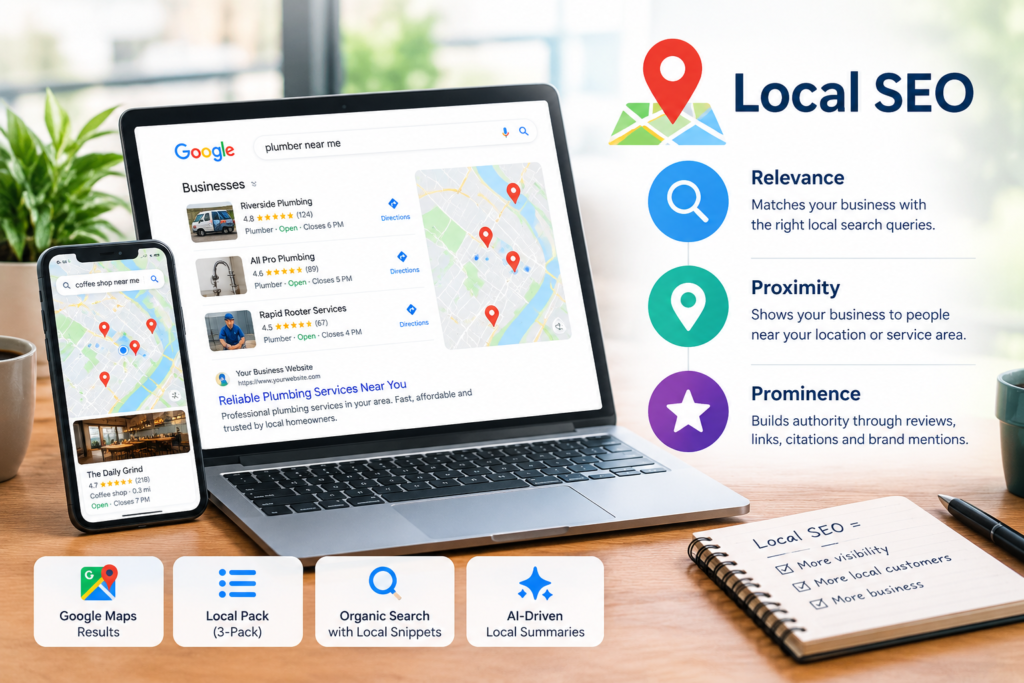
Local SEO surfaces include:
Google Maps results – the map listings that pop up when you search for local services
The Local Pack (3-Pack) – the top three business listings that show up prominently in search results with ratings, hours, and contact info
Organic search results with local snippets – standard blue-link results filtered by location
AI-driven local summaries – newer features where Google summarises local business info from reviews and citations
Google uses three main local ranking factors to decide which businesses show up:
Relevance – how well your listing, categories & content match the searcher’s query & local keywords
Proximity – how close the searcher is to your business location or service area
Prominence – overall authority based on online reviews, links, local citations, and brand mentions
Local SEO optimises visibility in location-based search results by working across all three of these pillars at the same time.
The Core Benefits of Local SEO for Small Businesses
Local SEO focuses on catching people at the point of highest intent. When someone types in “emergency plumber Queens” or “cabinet door repair Hoboken”, they’re not casually browsing – they’re ready to call, visit, or book – usually pretty quickly. Local searches often indicate high purchase intent, and a quarter of local searches result in a purchase.
High-Intent Visibility
Local SEO helps get you in front of customers at the moment they are searching. Over three-quarters of people who search locally visit a business within a day, and almost 50% of smartphone users visit a business the same day they search.
These aren’t just window shoppers – these people are buying. Local SEO targets high-probability local consumers who are looking for services nearby.
Securing the Map Pack
High visibility in Google Maps puts you front and center for local searches. The local pack appears above most organic search results, especially on mobile.
A well-executed local SEO campaign can get you a spot in the Google Local Pack, which captures most of the clicks, calls & direction requests.
Clear map listings and accurate business hours drive direct phone calls and visits.
Local Trust and Authority
Positive reviews and localized content build trust and can increase conversion rates.
When potential customers see a business with dozens of recent reviews, consistent information, and detailed service pages, they feel a lot more confident about calling.
Prominent placement in local search results builds trust & credibility over time.
Leveling the Playing Field*
Local SEO is the secret sauce that lets small shops outmuscle national chains on local search queries. Think of a locally-optimized cabinet repair business that just happens to outrank a Home Depot for “kitchen cabinet repair” in their own backyard.
Let’s take a few examples. There was a café in downtown NJ that sorted out its Google Business Profile, threw up some fresh photos, and localized its menu,u and suddenly they were getting a whole lot more foot traffic within months. And on the East Coast, a physiotherapist in the burbs who cleaned up their citation consistency and built some city-based pages saw their new patient calls double over a few short months. And in New Jersey and New York, a cabinet restoration business that sorted out their service pages and got their customers to leave reviews started getting a steady flow of quote requests – in fact, more often by way of Google Maps than from their paid ads.
Local SEO is a really powerful way to drive direct phone calls and actual in-store visits to your business. And it does this by making you more visible in the eyes of the locals.
Why Local SEO Leaves Every Other Marketing Channel in the Dust
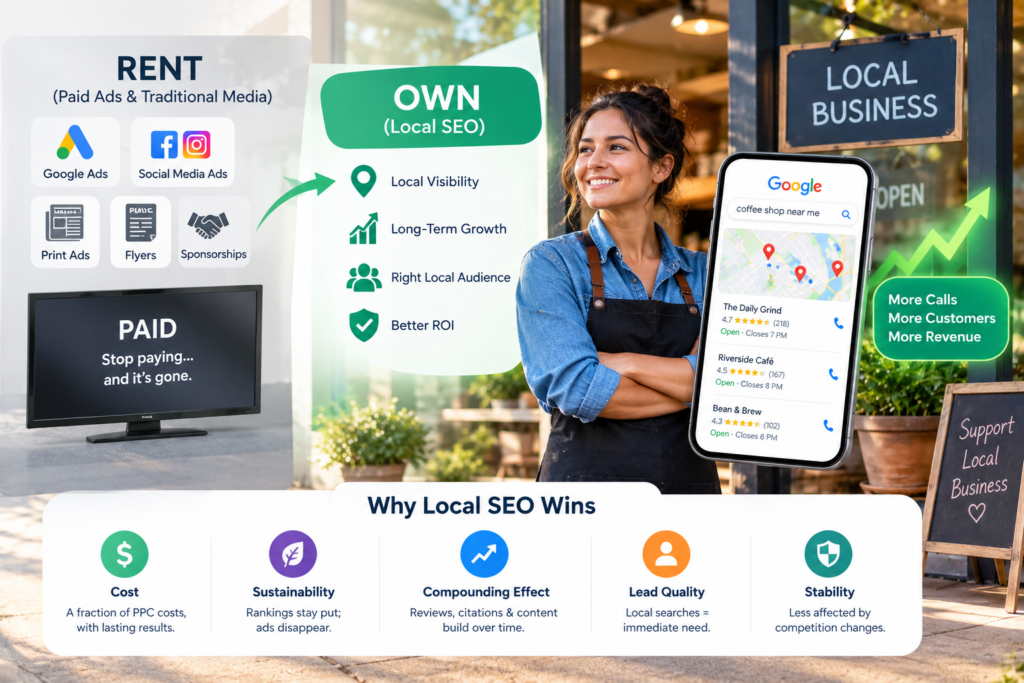
Small businesses are always juggling a load of different marketing channels – print ads, flyers, sponsorships, Google Ads and social media – but most of those stop working the moment you stop paying for them.
The ‘rent vs. own’ analogy is a good one here. Paid ads and traditional media are like renting a TV or a cinema screen. You pay, people watch, you stop paying, and they vanish. Local SEO is more like buying a TV or a cinema screen – you’ve got something that you can make the most of for years to come.
Local SEO is all about focusing your marketing efforts on the people who live in your area, which means you’re not wasting your budget on strangers from three states away. Local SEO gives you a higher return on investment than a broad advertising campaign because every dollar you spend goes straight into attracting people who are right on your doorstep.
Let’s look at some numbers. One family-owned HVAC business in Southern California put aside $1,200 a month for local SEO, and within 90 days they went from getting 12 solid leads a month to a whopping 89 – generating $156,000 in brand new revenue in the process. And that’s a customer acquisition cost that paid advertising rarely comes close to matching.
Local search is a level playing field where smaller brands can outdo the big boys. Local SEO brings in customers organically and means you’re not stuck relying on expensive advertising. And since local searches usually mean people are looking for something right now, the conversion rates are through the roof compared to a broad campaign.
Here are the key comparison points:
- Cost: Local SEO is a fraction of the cost of ongoing PPC but delivers results that keep on growing
- Sustainability: Your rankings stay put; ad spend disappears when the budget dries up
- Compounding effect: Reviews, citations and content build on each other month after month
- Lead quality: Local searches indicate an immediate need, so the leads convert at a much higher rate
- Stability: Local rankings are more resilient than ad auctions, which go up and down with the competition
A small water damage restoration business that used to rely on HomeAdvisor or Thumbtack leads and then started working on local SEO for a few months saw a higher volume of free organic calls than the expensive third-party leads they were used to – that’s a scenario we see time and time again.
Key Local SEO Assets: Google Business Profile, Website and Citations
At the heart of local SEO are three key assets: your Google Business Profile, your website and your network of local citations and business listings.
Your Google Business Profile is probably the most important local listing going. It’s the one that comes up in Google Maps and the local pack along with your photos, opening hours, reviews, services and contact details. Local SEO involves sorting out your Google Business Profile for maximum visibility – and the effect is really measurable. Having a complete Google Business Profile boosts visits by 70% – and 36% of SEOs reckon it’s a crucial factor in local rankings. And businesses with updated profiles are 50% more likely to attract customers. An optimized Google Business Profile is a great way to drive direct interactions with customers. And if you add photos to your Google Business Profile, engagement goes right up. Another aspect that a lot of small business owners often ignore is the website. The full effect of Local SEO only takes place when you optimize your website for local searches with detailed service pages, city and service-area pages (like “Appliance Repair in Staten Island”), FAQs, before-and-after pictures, and clear calls to action. You must embed relevant local keywords, create localized content in the form of blogs or service area pages, and put your address and phone number front and center. This helps search engines understand where you’re based.
The third most important aspect is local citations. Online pages on third-party websites that mention your business name, address, and phone number. If you are doing local SEO for your business, having a listing on Yelp, Angi, local chamber sites, Facebook, Nextdoor, Apple Maps, and some other niche directories is a non-negotiable. Keeping your citations consistent builds confidence for Google that your business is the real deal
How Local SEO Really Works: The Signals Google Uses to Rank You
Local search uses a whole different set of ranking factors than standard SEO – understanding them helps you know where to focus your time and money.
Relevance
- The categories you’ve listed, business description, services, and on-site content in your Google Business Profile and website.
- If you’re a cabinet restoration business, clearly listing “cabinet refacing”, “cabinet refinishing”, and “water-damaged cabinet repair” in both your verified Google Business Profile and on your website pages is a big help in getting matched up with those searches.* Making your business more relevant locally (such as with service pages for individual neighborhoods and FAQs) really helps get across that signal.
Being in the Right Place
- How close the person searching is to your shop or your defined service area
- in a place like New York or Jersey City, this can change almost block by block
- you can’t control where someone searching is standing, but you do get to decide your service areas and build city pages to tell Google you matter more than just your address
Having Some Cred
- how much online authority you have from reviews, backlinks, local citations, media mentions, and engagement
- good reviews and customer feedback all count towards your local search cred
- good reviews get you higher in the rankings
- being accurate and having great reviews makes people trust you more and think you’re a reputable business
- more reviews and the right kind of links mean you’ll be taken more seriously
Researchers think that Google Business Profile signals are about 32% of what gets you a good ranking, reviews are around 20%, and on-page SEO is around 15% – the rest is just other signals like links and how people behave online
Getting a Better View: Local Search Maps and Rankings
One of the best ways to get a handle on how you’re doing locally is with a geo-grid or local search grid.
[Before Local Search Grid Screenshot]
[After Local Search Grid Screenshot]
A geo-grid is basically a map overlay with a bunch of dots around your business or service area. Each dot shows your ranking for a specific search term in that area. If you’re number one or two, those dots are green (you’re killing it); if you’re 4-10, it’s yellow or orange (you’re visible but not the top choice), and if it’s 11,+ you’re basically invisible.
Tools like Local Viking or BrightLocal let you track things like “cabinet repair” or “emergency plumber” across your whole service region. Google Maps is really good at showing up high in the search results for nearby services, and the grid shows you exactly where you’re doing well and where you’re struggling.
Why does this matter?
- Moving those dots from red to green is directly linked to getting more calls, website clicks, and revenue – one plumbing company doubled their calls in just 30 days after they got their local SEO together. A home services business can see their visibility grow from just their own neighborhood to multiple surrounding towns as they work on their local SEO
- Businesses like Dr. Cabinet measure success not just by how high they rank but by actual actions – calls, form submissions, booked in-home estimates, and direction requests.
Why You Need to Partner With a Local SEO Agency to Get Real Results
Most business owners – contractors, doctors, shop owners, cabinet makers – are way too busy running their day-to-day operations to be experts in every little technical bit of local SEO. That’s completely fair.
An experienced local SEO agency takes care of the hard stuff that really makes a difference:
- optimizing your Google Business Profile – filling out every field, picking the right categories, managing photos and Q&A
- review generation and response processes – getting more reviews and responding to them in a way that looks good to the customer
- local keyword research – figuring out what local searches really matter and then making sure you have the right pages to match them up with
- citation cleanup – fixing up all the online listings that might have your business name wrong
- technical improvements – making sure your website is fast and looks good on a phone
- search console analysis – figuring out how to make your pages work better online
We’ve worked with a bunch of different types of businesses – from cabinet restoration to healthcare and everything in between. We know which local SEO tools to use, how to read the data, and how to avoid the mistakes that can tank your business.
How Local SEO Drives Real-World Results – like Calls and Revenue
Rankings are great, but what really matters is the phone ringing, people asking for quotes and customers walking through the door.
A good Google Business Profile with photos, services and Q&A gets people to interact with you on Google Maps – tapping the call button, getting directions, and clicking on your website. Good local SEO gets you in front of the customers who are already looking for something like your business.
Putting in the work on local SEO means you can connect with nearby customers who are searching for things like “cabinet refacing Bergen County”.
Here are some examples of what this looks like in real life:
- A local spa did some work on their Google Business Profile and added some neighborhood pages and, in just four months saw their weekday bookings double as their local search visibility got stronger.
- A cabinet repair company built pages for specific towns in NJ, and as those pages climbed in the search rankings, they started getting more “free estimate” requests.
- A business like this can just track how many calls and visits they get and not just how high they rank. A dentist office has optimized its profile with key details and booking links – this has led to a rise in new patient calls from people actively searching for a local business in their area, filling in cancelled appointment slots.
Local SEO helps businesses with a physical presence to catch the attention of potential customers. Local SEO is pretty much essential for small businesses wanting to improve their ranking in local searches. In fact, businesses with a well-optimized Google Business Profile are 70% more likely to attract some foot traffic, and the fact is that 50% of people using smartphones do pop in to see a business that day.
Essential Local SEO Tactics Every Small Business Should Be Implementing
Here’s a to-do list made up of practical foundational actions any local business owner can start on or leave to someone else:
- Finish setting up your Google Business Profile. Get everything filled in: business name, categories (including your primary and secondary ones), address and phone number, business hours, services, description, and any other useful attributes. Having a complete Google Business Profile really helps with local search visibility. Don’t forget to add new photos regularly – there’s a boost to engagement from adding photos to your Google Business Profile.
- Get to grips with local keyword research. Use tools like Google Keyword Planner or another research tool to get to the bottom of what local searches are being made. Take those relevant keywords and map them onto specific pages: “cabinet refinishing Newark NJ” should go on a dedicated service page, not buried on the homepage.
- Build and tidy up your local citations. Take charge of listings on major business directories and any relevant niche platforms. Make sure your name, address, and phone number are the same everywhere. Having consistent NAP citations across the web really boosts business trustworthiness in local SEO. Remove duplicates and keep it clean.
- Improve your on-page local signals. Get local headings sorted, embed Google Maps on your contact page, write some local FAQs, make sure mobile performance is fast, and put “Call Now” or “Get a Free Estimate” in an obvious spot.
- Get online reviews flowing in. Set up a system for the job – emails, SMS reminders, or even print-out cards. Encourage reviews after every job is finished. Responding to reviews is essential for building trust with customers. You know, 89% of people check online reviews before making a purchase.
- Create locally relevant content. Make pages that are targeted at specific locations, share local case studies, and post pictures of your work in the area. The message this sends to Google – and your potential customers – is that you’re relevant to that area.
- Get out and about in your local community. Consider sponsoring events, joining your local chamber, or even teaming up with other local businesses to cross-promote each other. This generates local backlinks and mentions that help build your online reputation.
Putting in the effort to optimize your local SEO means businesses connect with customers right on their doorstep. Local SEO is a game-changer for small businesses getting found by customers who are ready to buy.
Local SEO for Different Types Of Local Business
The core principles of local SEO don’t change, but how you implement them does.
- Brick-and-mortar locations (retail shops, cafes, salons, gyms) rely on being close by and having foot traffic. Getting in Google Maps, adding photos, getting your business hours spot on, and having a solid local search presence are all key. The majority of local searches are done on mobile, so your profile and site need to look the part on a phone.
- Service-area businesses (plumbers, electricians, cabinet restorers) need to define their service area properly in their Google Business Profile and create structured city and region pages to rank in local results outside their physical locations. This is how a business like Dr. Cabinet can appear in local search results across multiple towns without having a shop in each one.
- Appointment-based professionals (doctors, therapists, dentists, lawyers) need strong reviews, clear specialties in their profile, and a simple way to book an appointment visible in local search. Local SEO is key as consumer behavior shifts towards mobile searches, and these professionals benefit most from making it easy to book on the spot.
- Multi-location businesses scale in different ways: each location should have its own Google Business Profile, a dedicated location page, and location-level reporting to track local SEO success.
Local SEO helps small businesses compete effectively for local market share – regardless of their specific business model.
Measuring Local SEO Success: Metrics That Matter
Don’t obsess over your ranking alone. Focus on what matters to the business.
The key metrics to track each month:
- Google Business Profile Insights: check profile views, the search queries that triggered your listing, call clicks, direction requests, website clicks, and photo views. Trend these over 3-6 month periods.
- Website analytics: look at traffic from organic local searches, form submissions, quote requests, and performance of your key local landing pages. Use Google Search Console to see which local queries drive impressions and clicks.
- Local rankings: Use tools and geo-grid maps to track positions in both Google Maps and organic search results across your service area. Tie this to call tracking to see what’s driving revenue.
- Conversion actions: track phone calls, booked appointments, completed contact forms, and in-person visits that result from local search.
Businesses with complete Google Business Profiles are 70% more likely to be visited – so tracking your profile completeness is itself a leading indicator. Set Realistic Timelines – The Long Game of Local SEO
Meaningful shifts in local search typically happen over the course of 3-6 months, with impact compounding over 6-12 months. Don’t get caught up in obsessing over daily fluctuations – local SEO is a marathon that requires consistent effort and patience.
Common Local SEO Mistakes That Cost Small Businesses Money
Lots of local businesses accidentally shoot themselves in the foot with simple, avoidable mistakes.
- Inconsistent NAP data – old phone numbers, dodgy address formats, or missing suite numbers across online directories confuse both Google and local customers. A quick scan of your top 20 listings can often reveal discrepancies that are quietly tanking your search engine visibility.
- Unclaimed or poorly optimized Google Business Profile – missing categories, blurry photos, blank descriptions, wrong hours, or unanswered reviews all look like you’re not in control of your business’s online presence.
- Thin or duplicate local content – city pages that are copy-pasted with only the city name changed are just not going to cut it. Google can spot this pattern from a mile off, and it won’t help your local SEO rankings. What you need is unique, locally relevant content that references real neighborhoods, landmarks, or project details.
- Ignoring reviews – not responding to feedback or, worse, trying to buy fake reviews will damage trust and could even trigger a penalty. Your online reputation is a core ranking and conversion factor.
- Tracking the wrong metrics – getting too hung up on keyword rankings without measuring calls, quote requests, or close rates means you’re flying blind up here. Tie your local SEO efforts to real revenue data.
Why Now Is A Prime Time To Invest In Local SEO
Local search and AI-driven local experiences are evolving at lightning speed. Google is introducing richer map interfaces, AI-powered business summaries, and more sophisticated ways to surface local businesses. Businesses with a strong reputation, reviews, and citations will be the ones featured in these new surfaces.
As more competitors wise up to the importance of local SEO, the cost – in time and effort – of trying to catch up will only increase. It’s way easier to maintain your position than try to gain ground from scratch when every other local service provider in your area is optimizing their stuff too.
The data backs up the urgency:
- 30% of all mobile searches are location-related, and that share is still on the rise
- 78% of nearby searches on mobile lead to an in-store visit
- 50% of smartphone users visit a business within a day of a local search
- 28% of local searches lead to a purchase
A cabinet repair company or any local service provider that got ahead of the game with local SEO is now reaping the benefits of compounding reviews, backlinks and local authority – while late starters are still invisible on the map.
Conclusion & A Strong Call to Action
Local SEO connects your business with customers ready to buy, builds long-term digital assets, ts and consistently outperforms one-off marketing tactics in both ROI and sustainability. It’s the growth engine that keeps working for you day after day, search after search.
For every other local business, investing in a local SEO strategy means more high-quality leads, steadier revenue, and a stronger brand in your city or region.
Ready to get a reality check on your business? Request a free local SEO audit and local search grid assessment from our team. You’ll get a snapshot of your current Map Pack visibility, a geo-grid showing your rankings across your service area, a priority keyword list and a short plan to get you back in the game.
Don’t wait for your competitors to lock down the top spots. Click “Get My Free Local SEO Audit” or just fill in a quick form with your business name, website, and main service area, and let’s get your business on the map.